
ALT1350 Superior Power Performance for Meters, Trackers and Sensors
Eight Years Later, Still the Benchmark: ALT1250 vs. ALT1350, Measured
In LPWA IoT, power efficiency is not a single number on a slide. It decides whether a device runs for three years, five, or fifteen. So when a new modem is announced and benchmarked against the ALT1250, we take it as a compliment and as an invitation to publish our own numbers, measured on both parts under identical conditions.
The ALT1250 has been shipping since 2018. It set the low-power reference for cellular IoT, and eight years later the industry still measures itself against it. That is a good outcome for a chip. It is also why we built the ALT1350: not to replace a part that connects tens of millions of devices, but to move a bar nobody else had moved.
We announced ALT1350 availability in 2024, with modules from leading manufacturers. Since then the ALT1350 has been designed into asset trackers, meters, and wearables and has shipped millions of units.
The LPWA Power KPIs That Actually Determine Battery Life
A modem has hundreds of measurable parameters. Three intrinsic ones govern almost everything built on top:
- Operating current — benchmarked as RX current, because it exercises most of the subsystem without adding external PA current.
- Retention current — how little you can draw while keeping state.
- Transition speed — how quickly you can wake up and get back to sleep.
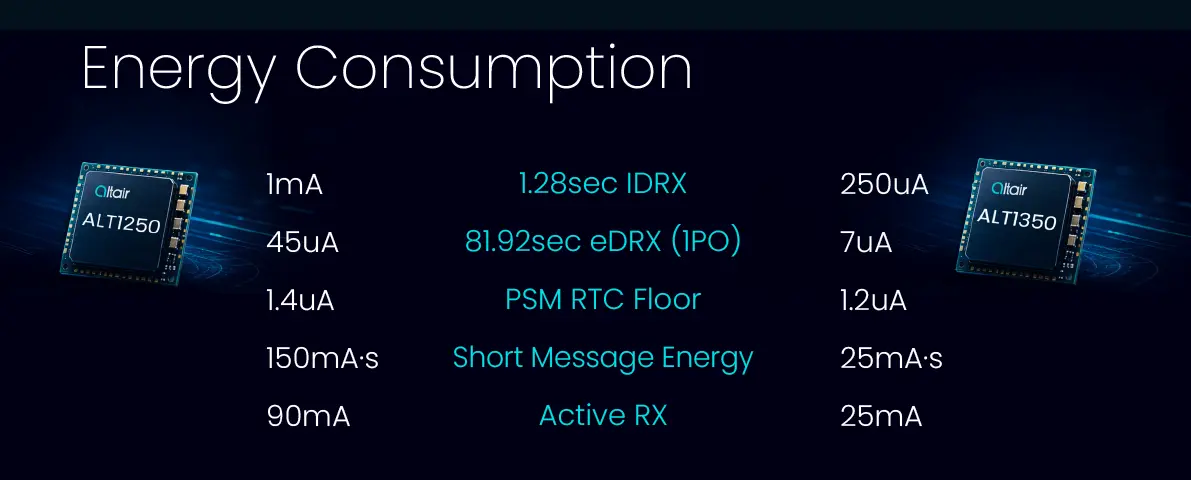
At system level, they reduce to a short list, short on purpose. These are the numbers that actually show up in a battery budget:
- eDRX average current — for a device that must stay reachable. The common gas-meter configuration is 81.92 s; some operators deploy cycles as long as 655 s.
- Energy per data event — for the 50-to-100-byte uplinks that dominate meter and sensor traffic.
- RX current — the proxy for active-mode efficiency.
- PSM floor — worth listing, and worth being honest about: at 1.2–1.4 µA there is almost nothing left to win. A deep-sleep number in that range will not change any battery budget.
ALT1250 vs. ALT1350: Two Generations, Measured the Same Way
The figure below compares the ALT1350 with the ALT1250 under identical test conditions. Both parts are measured on full reference designs, and the numbers include everything a real device pays for: I/Os, clock sources, memory, and the peripheral components, including PA current and leakage. eDRX figures at PTW 2.56 s (2 Paging Occasions). Data-event energy at ~50 byte uplink payload.
The one exclusion is SIM card power, since the SIM/eSIM is an external component choice, though we do assume it supports low-power suspend/resume operation.
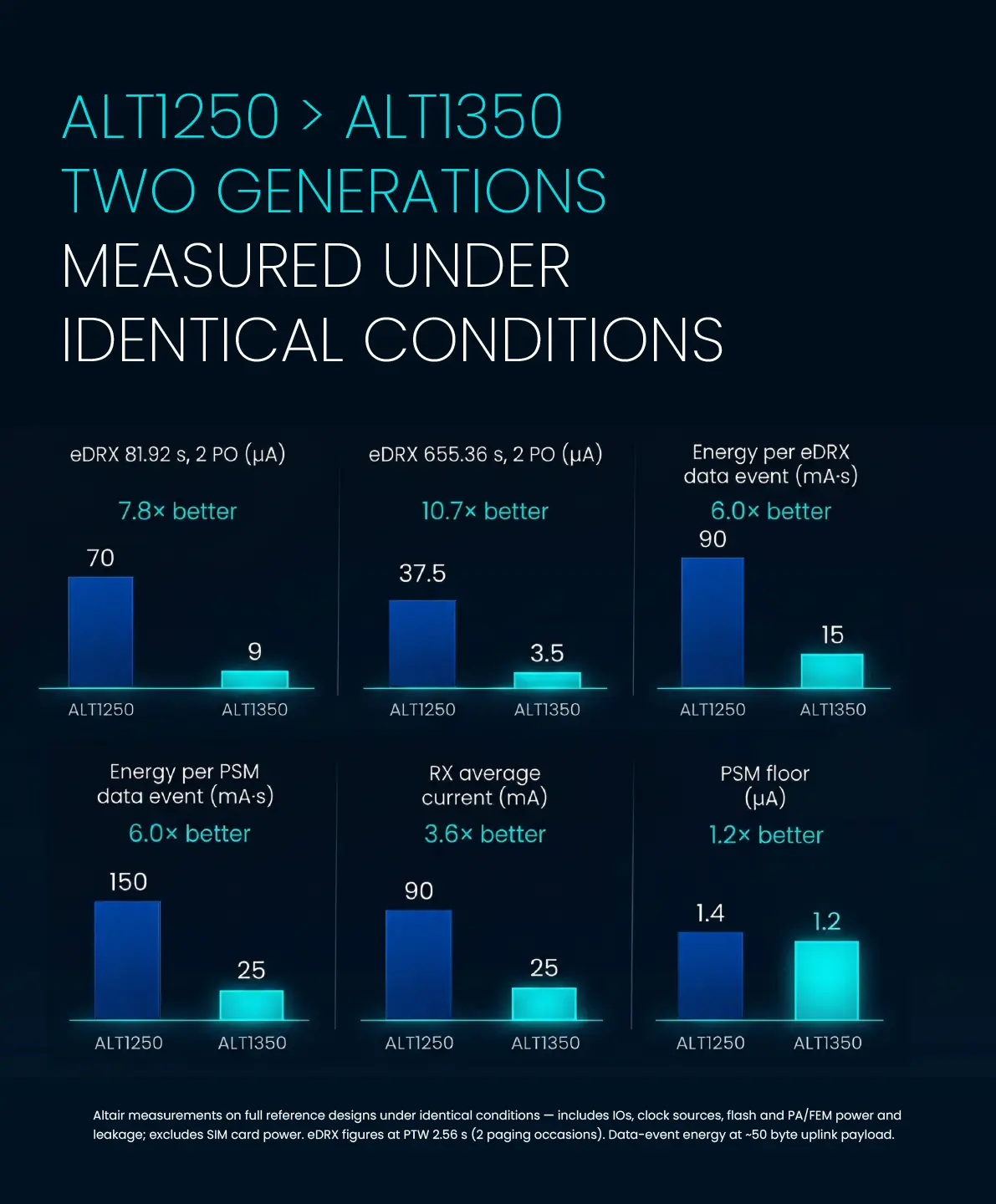
Everything that shows up in a battery budget, reachable standby, energy per event receive current moved by 3.6× to 10.7× in one generation. The PSM floor barely moved, because there was nowhere left for it to go, and it delivers diminishing returns for cellular applications.
What the Recent LPWA Modem Benchmark Actually Claims
A recently published benchmark measured Qualcomm’s new E51 modem in its own lab and compared the results against the ALT1250. The stated claims: more than 20% power savings across all power modes and 33% lower deep-sleep current in eDRX.
We decided to test the claims. We took the operating points from published battery-life charts and re-ran the same tests on both generations of Altair silicon, under the conditions the benchmark states:
- 23 dBm worst-case Tx
- eDRX with a 2.56 s PTW and 1.28 s iDRX
- cDRX at 320 ms / 8 ms / 100 ms, and a 5 s RRC inactivity timer
Same scenarios, same targets, same axes.
One note on the method used before we reveal the results. The published benchmark compared its lab-measured part against ALT1250 datasheet specifications. In our study everything attributed to Altair below is physically measured, on full reference designs, on both parts: ALT1250 and ALT1350.
The Same Battery-Life Scenarios, Run on Current Silicon
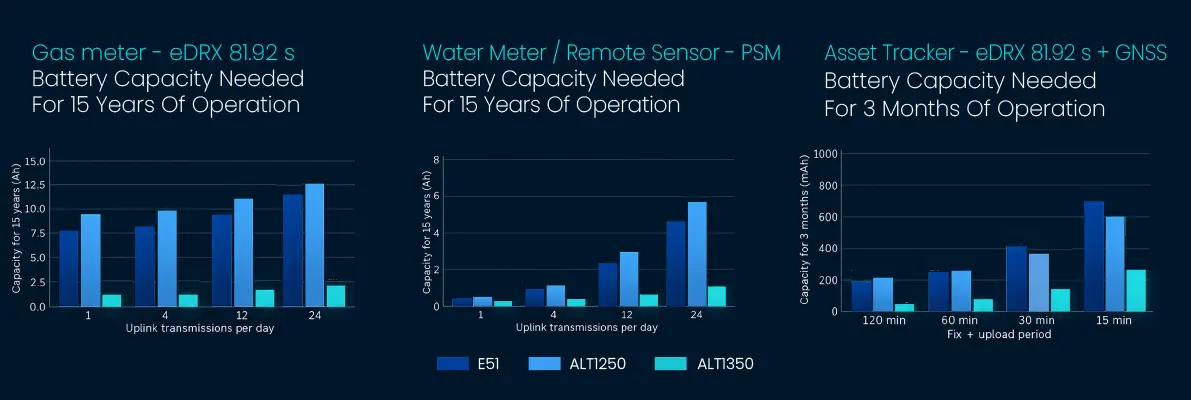
In the case of the 15-year gas meter that uses eDRX 81.92 s, the E51’s published curve runs from 7.5 Ah at one uplink per day to 11.2 Ah at twenty-four. Our measured ALT1250 runs from 9.3 to 12.4 Ah. So the new part needs 9% to 19% less battery than the ALT1250, and “more than 20%” is a fair description of its best case.
The ALT1350 runs from 1.2 to 1.7 Ah. That is 6.3× less battery than the published curve and the factor is essentially flat across the entire range: 6.2× at one uplink per day, 6.5× at twenty-four. This is not an operating point we picked. It is the whole sweep.
Two things a datasheet will not tell you
We compare at 2 PO because those are the conditions the benchmark states. It is not the configuration we optimize for.
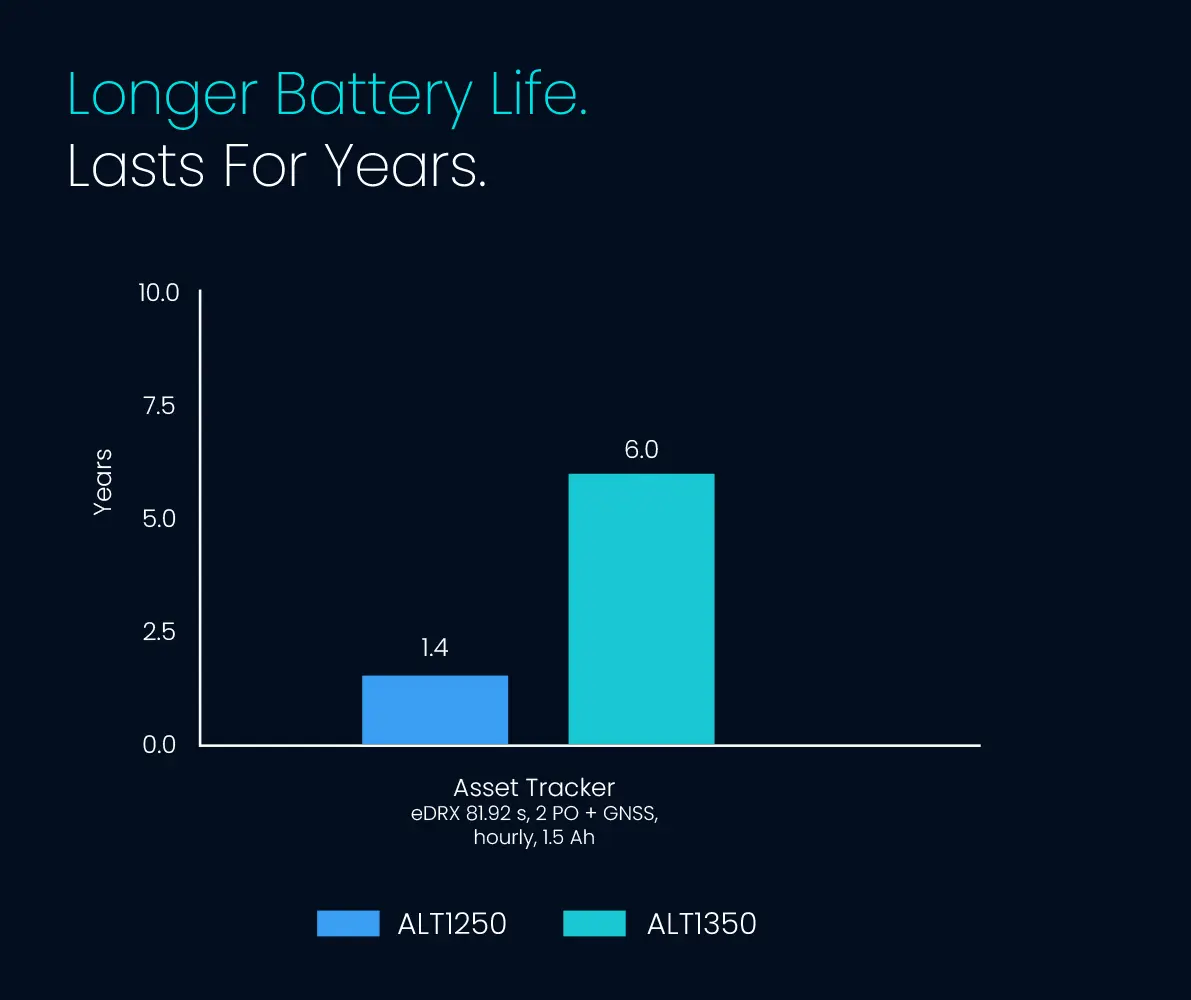
The ALT1250 is tuned for single PO and eDRX cycles of 81.92 s or shorter — the configuration behind Japan’s smart gas meter rollout, to our knowledge the largest eDRX deployment in the world. At that operating point it delivers at least 25% more battery life than the 2 PO figures above.
And optimizing for lifetime is not only about power. We also account for flash endurance, where a write can happen up to 15 million times over a device lifecycle, so on short eDRX cycles, we simply do not write.
Low-Power Roadmaps: Why the Generation Matters More Than the Percentage
A one-time percentage advantage over a mature reference part is easy to publish and hard to trust. Sustained, measured, generation-over-generation improvement is what a real low-power roadmap looks like. Measured against the same ALT1250 the industry keeps using as its yardstick, the ALT1350 delivers reachable eDRX standby down to 3.5 µA, 83% less energy per data event, and 1.7× to 6.5× less battery than the E51 across its own published scenarios.
So when a new part is compared with the ALT1250, it is being benchmarked against a part we have already surpassed by a wide margin. The relevant comparison is not new silicon against our previous generation. It is new silicon against our current one.
Power Is a System Property, Not a Modem Spec
A modem-only current figure also misses where real battery budgets are won or lost. The ALT1350 is a single-chip system: an integrated low-power application MCU with 1.3 MB of Flash and 752 KB of RAM, an always-on sensor hub that collects and processes data while the modem sleeps, iSIM, integrated GNSS & Cell based location, on-chip non-volatile memory, Wi-Fi-based positioning at a fraction of the power and the cost of a dedicated Wi-Fi IC, and NTN satellite connectivity all in the same device. No modem-only benchmark captures any of that, and it dwarfs a single-digit delta in any one power mode.
Refreshing an ALT1250 Design: Should You Move to the ALT1350?
This is the question we actually get asked, so here is the direct answer. The ALT1250 remains a strong part, in production and shipping.
A deployed ALT1250 battery operated meter is not a mistake, it is the design the rest of the industry is still measured against.
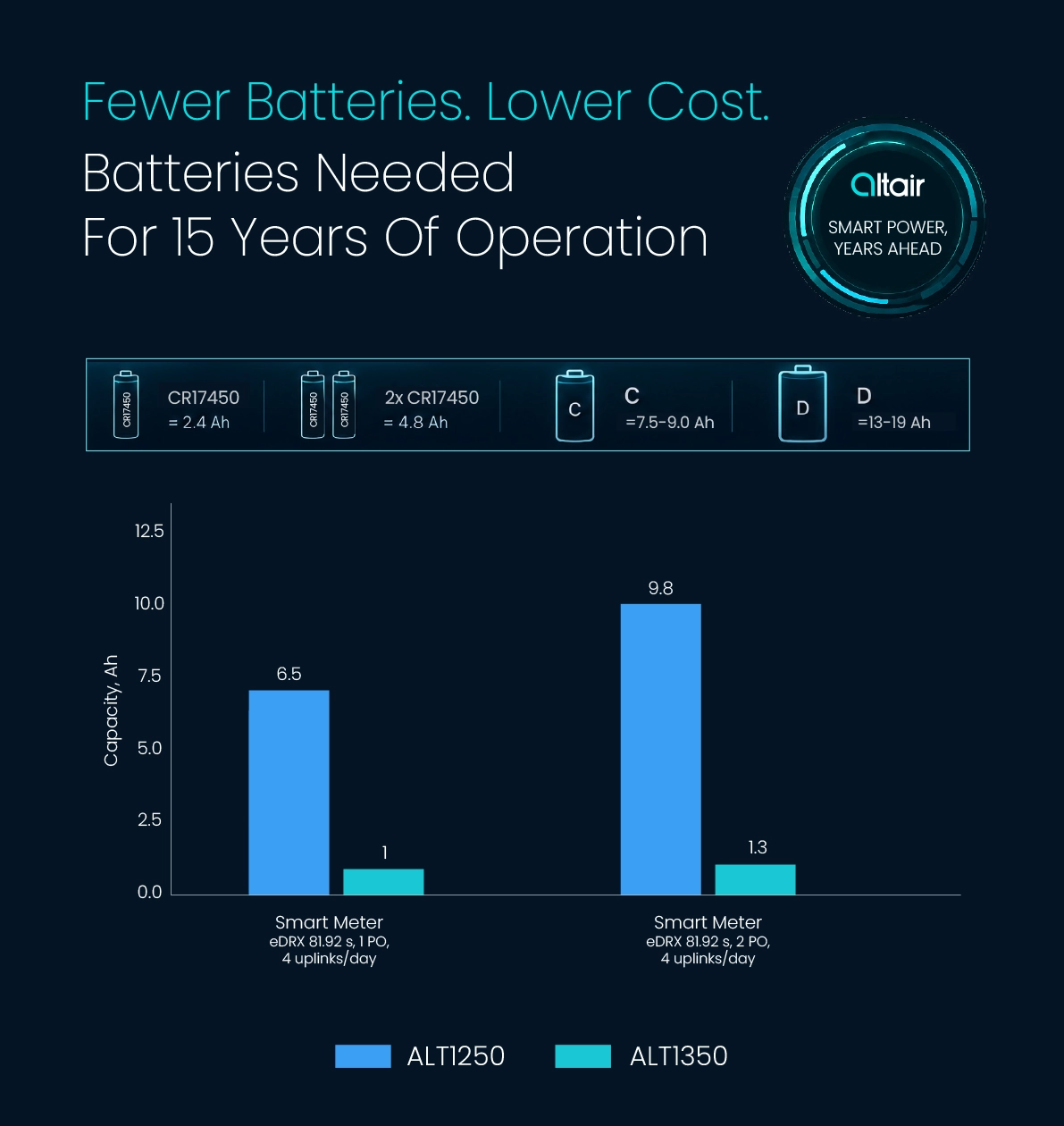
But if you are opening a battery-operated design for a refresh, a gas or water meter in particular, the arithmetic is not subtle, and it gets less subtle once you go shopping. Cells are discrete: there is nothing between one can size and the next, and every design adds margin on top.
To reach 15 years, an ALT1250 design needs a D-size cell. An ALT1350 design closes the same requirement on a CR17450, with margin to spare. That is not a spec-sheet delta, it is a different bill of materials: a smaller enclosure, a fraction of the lithium to buy, ship and certify, and everything that follows for mechanical design, cost and logistics. That is a different product.
Built to Last: Altair’s Experience, Certified and Deployed
At Altair Semiconductor, ultra-low-power cellular connectivity is not just a feature. It is what the company was built around from day one.
But power efficiency is only part of the story. Both the ALT1250 and the ALT1350 are globally certified, field-proven solutions, deployed across thousands of use cases, operating scenarios and carrier combinations. That experience taught us something: every customer is different, what they care about is different, and the corner cases are different. It has been a demanding education, and everything we learned from it is now built into ALT1250 and ALT1350 firmware — the flash-endurance decision earlier is one example of many.
The ALT1250 is still winning new designs, many of them battery operated, on the combination of its power consumption, its overall system performance and eight years of field maturity.
We are proud to power what is next in IoT, and we will keep publishing our progress as the ecosystem moves toward 5G. We will be there with eRedCap as well.
Want to see how the ALT1350 or the ALT1250 perform in your design? Contact our team to get the full data set.
Notes on sources and conditions:
Figures attributed to the benchmark are taken from its own published post, quoted from its text or read from the operating points of its published battery-life charts for its own silicon under its own stated conditions.
Altair has not tested that device.
Battery capacity figures are usable discharge capacity. They exclude self-discharge, passivation and low-temperature derating, which apply equally to all parts.
Related resources


Altair Cellular IoT chipset, ALT1250, is the most integrated, dual mode LTE CAT-M and NB-IoT chipset with 2G fallback.
Success Story

Altair’s Ultra-Low Power Chipset Opens New Opportunities in the Vehicle Telematics Market.
White Papers

LTE-M & NB-IoT are redefining IoT connectivity with superior battery life, enhanced coverage, and cost efficiency—outperforming Cat 1bis in every critical aspect. As future-proof solutions integrated with 5G networks, LTE-M & NB-IoT ensure long-term reliability for your IoT deployments.
Blog

In the next few years, fundamental technological changes in wireless communications are set to revolutionize healthcare applications.