
HD-FDD: Enabling Cost-Effective, Power-Efficient IoT Device Design

Keep up to date on the latest industry trends, company updates and product features.
By Guy Cohen, Director Product Management
Cellular IoT is everywhere — monitoring city infrastructure, tracking assets, measuring agricultural data, and reading smart meters. Scaling IoT brings critical challenges: devices need to be both affordable and reliable. They must run for years on a single battery, meet carrier-grade standards, and work flawlessly everywhere — from city centers to remote locations, where maintenance isn’t an option. When a single device failure can eliminate ROI, there’s no room for compromise.
Sony Semiconductor Israel has pioneered cellular IoT technology, leveraging proven approaches like HD-FDD — a fundamental technology in LTE-M and NB-IoT with proven benefits that make it essential for future IoT standards. With over a decade of experience, SSI knows how to help device vendors build competitive products that meet real-world demands.
The Evolution of IoT Device Requirements
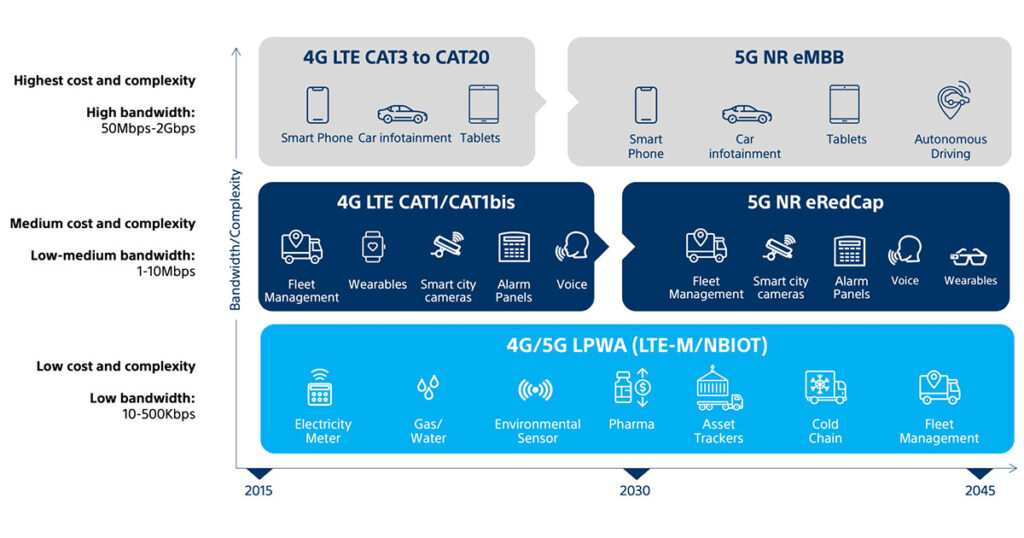
Today’s cellular IoT landscape divides into two main categories: LTE-M and NB-IoT serve low-power wide-area (LPWA) applications, while emerging 5G standards like eRedCap address mid-range IoT use cases. Traditional cellular devices prioritize high throughput and network capacity, but IoT applications require:
- Cost efficiency for large-scale deployments
- Extended battery life for remote operations
- Global scalability across different regions and networks
- Reliable coverage, including in challenging environments
These requirements drive innovation in device design, particularly in RF front-end architecture.
HD-FDD: A Simplified Approach to RF Design
FDD systems work like a two-lane highway — one lane for incoming traffic, one for outgoing, running simultaneously. This operation mode requires complex design on the device side, including duplex filters to manage RF signals. HD-FDD still uses separate frequencies for downlink and uplink like FDD, but doesn’t transmit and receive at the same time.
This simpler device design eliminates the need for duplex filters, which maintains signal quality while reducing costs and complexity, making it more cost-effective and efficient for many applications.
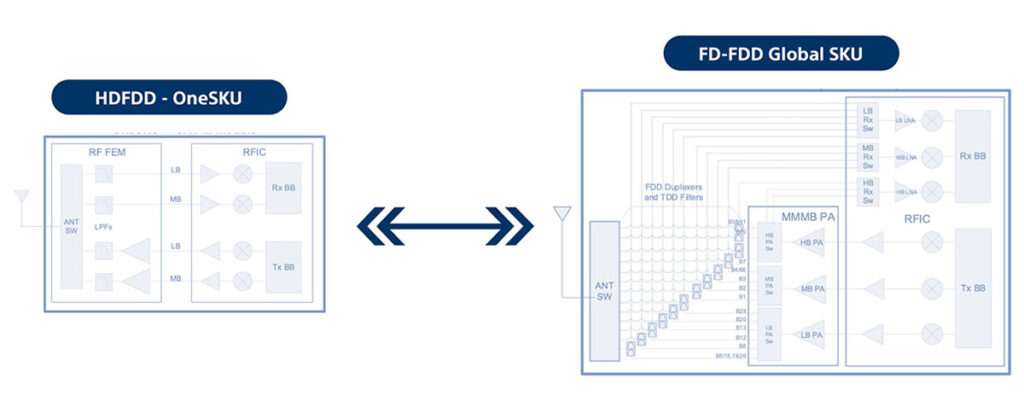
With this simplified RF architecture, HD-FDD delivers four key advantages:
- Reduced bill of materials (BOM) cost through eliminated components
- Improved power consumption and reduced peak current
- Enhanced flexibility for global deployment across regions
- Simplified PCB design for more efficient manufacturing
Quantifiable Benefits for Device Vendors
For IoT device manufacturers competing in tight-margin markets, HD-FDD’s technical advantages translate directly to business results. The simplified design reduces development risks, accelerates time to market, and enables profitable scaling — especially critical when rapid deployment can make or break market success.
HD-FDD delivers four core business advantages:
- Lower Production Costs
- Significant cost savings per unit by eliminating SAW/BAW duplexers
- Reduced manufacturing complexity through simpler PCB design
- Lower inventory costs with single SKU design
- Reduced Time to Market
- Faster development cycles with simplified RF design
- Single global certification process instead of regional variants
- Reduced validation time through proven technology
- Performance at Scale
- Extended battery life through superior power efficiency
- Improved coverage with enhanced receiver sensitivity
- Simplified thermal management with lower peak power consumption
- Global Scalability & Future-Readiness
- One design for worldwide markets
- Ready for emerging 5G IoT standards
- Proven in millions of devices globally
- Full support from SSI’s development tools and expertise
Implementation Considerations
While HD-FDD delivers significant advantages, successful implementation requires careful attention to three key design challenges:
- RF design quality. Today’s IoT chips pack multiple functions — baseband, RF, MCU, and location capabilities — onto a single chip. Traditional designs use SAW filters to clean up RF signals, but HD-FDD’s filter-free approach requires a different strategy.
Think of it like a professional recording studio versus a podcast setup: without specialized filtering equipment, you need excellent baseline sound quality. Similarly, HD-FDD demands fundamentally clean RF design from the start.
SSI addresses these design challenges through both hardware and software innovations, ensuring clean signal quality without relying on expensive filtering components. - Timing and Switching. HD-FDD’s approach of alternating between sending and receiving creates a unique challenge: The system needs to smoothly switch between different frequencies while maintaining precise timing. This requires accurate control of the RF systems, particularly during the crucial moments of switching between transmission and reception.
- Performance Integration. Making these elements work together efficiently is key to unlocking HD-FDD’s benefits. While the technical implementation is complex, the result is straightforward: Device vendors get the cost and power advantages of HD-FDD while maintaining the reliable performance their products demand.
Getting RF design right creates lasting competitive advantage through both cost structure and performance — setting products apart from designs that rely on expensive components.
Recent advances in semiconductor technology, such as Sony’s ALT1350 cellular IoT chipset, demonstrate how these challenges can be effectively addressed while maximizing the benefits of HD-FDD architecture: Reduced BOM costs through eliminating SAW/BAW filters, enhanced power efficiency for longer battery life, and proven RF performance that meets carrier certification requirements worldwide.
For vendors, this means faster time to market with globally deployable products that maintain high performance while reducing production costs.
Looking Ahead: HD-FDD in 5G IoT
5G IoT is coming, and HD-FDD technology is already part of the 5G ecosystem through LTE-M and NB-IoT, proving its value for IoT applications. Given HD-FDD’s success in these deployments, SSI believes strongly that it should be adopted in 5G Release 18 eRedCap for next-generation IoT products.
The math is simple: When you’re scaling from thousands to millions of IoT devices, small cost savings create major competitive advantages. HD-FDD’s specific technical features for 5G — including 5MHz bandwidth support and relaxed coexistence conditions — help vendors hit the market’s demanding targets:
- Lower per-unit production costs
- Extended battery life
- Reliable performance at scale
- Global deployment capability
Partnering with SSI means accessing both cutting-edge technology and proven IoT expertise. As enterprises roll out large-scale IoT deployments, they need solutions that balance strict budgets with carrier-grade performance. HD-FDD technology delivers exactly what it takes to win and execute these contracts.
Related Resources

Altair Cellular IoT chipset, ALT1250, is the most integrated, dual mode LTE CAT-M and NB-IoT chipset with 2G fallback.
Success Story

Altair’s Ultra-Low Power Chipset Opens New Opportunities in the Vehicle Telematics Market.
White Papers
LTE-M & NB-IoT are redefining IoT connectivity with superior battery life, enhanced coverage, and cost efficiency—outperforming Cat 1bis in every critical aspect. As future-proof solutions integrated with 5G networks, LTE-M & NB-IoT ensure long-term reliability for your IoT deployments.
Blog

In the next few years, fundamental technological changes in wireless communications are set to revolutionize healthcare applications.