
Low Power Chips
Pioneering Ultra-Low Power Consumption
for Next-Generation IoT Devices

Altair’s approach to minimizing power consumption is a cornerstone of our technology. It combines innovative silicon design with tailored software development — engineered from the ground up specifically for IoT.

This hardware foundation is complemented by software focused on leveraging low-power capabilities to directly address real-world IoT requirements.

Our deep expertise in cellular IoT and LPWA (Low Power Wide Area) standards, combined with experience helping customers navigate production and operational challenges, reinforces our position as a leader in the field. That commitment runs through the full lifecycle — from design and development through to deployment — ensuring our solutions are efficient, robust, and tailored to the needs of the IoT landscape.
How We Achieve Industry-Leading Efficiency
Altair technology sets the benchmark for low power consumption in IoT devices through a combination of advanced technical approaches.
At the core is the use of advanced silicon processes designed for low clock speeds, combined with optimized RF (Radio Frequency) and physical layer design to minimize energy use. By focusing on lower-frequency DSP (Digital Signal Processing) and accelerator blocks and adopting architectures that operate efficiently at reduced frequencies, our devices require less power and fewer transistors to perform their tasks.
We further enhance power efficiency through smart memory integration, enabling our systems to operate on less power, boot up faster, and reduce energy spent on memory operations.
Deep sleep modes are another key part of our power-saving approach. In these modes, the device shuts down components it doesn’t need, dramatically cutting power use during idle periods. This allows our IoT devices to consume very little power during downtime, making them significantly more energy-efficient overall.
Our firmware is continuously refined to reduce background activity, lower processing demands, and apply effective power management strategies. Beyond individual device optimization, we invest in system-level improvements across the IoT ecosystem — collaborating on network infrastructure, protocols, and software to ensure power savings at every level.
Battery Life in Practice
As leaders in low-power IoT, we understand the value of long battery life for IoT devices. Estimating battery lifetime can be challenging, with many parameters to consider: rate and size of data transmission, device accessibility requirements, protocol selection, and more. We’ve drawn on our experience to provide typical use cases — as used by our customers — to demonstrate the efficiency of Altair modems.
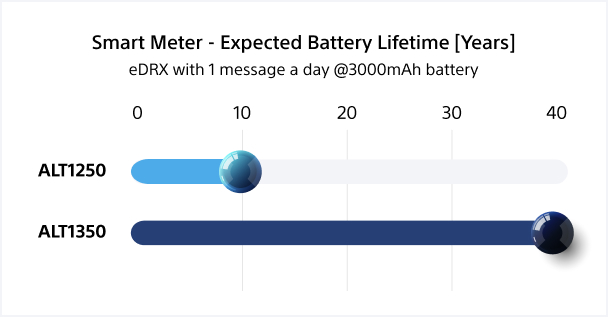
The above figure shows estimated battery lifetime for an example smart meter, considered a critical infrastructure, operating in cellular IoT network.
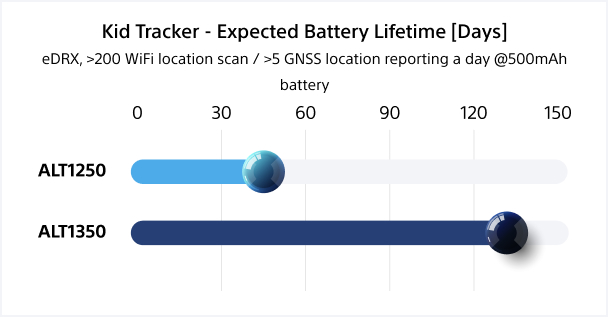
The above figure shows estimated battery lifetime for an example kid tracker application, limited in resources, operating in cellular IoT network and providing outdoor (GNSS based) and indoor (WiFi based) location.

Related Resources


A technologist's view of the Integrated SIM (iSIM), featuring Rotem Gazit, CEO of The Arad Group, a world leader in the field of connected water metering solutions.
Videos
The Integrated SIM (iSIM) provides your IoT devices with a simple, secure and cost-effective solution essential to meet the IoT opportunities of tomorrow - today.
Videos

The CEOs of the companies behind the integrated SIM (iSIM), Altair, Kigen and Vodafone, explain how they are answering customer challenges with the iSIM.